
—Toward the Practical Implementation of “Shallow Subsurface Risk Visualization” Using DAS with Spatial Resolution as Fine as 1 m and Ambient Vibrations—
Neubrex Co., Ltd. (Kobe, Japan; President: Kinzo Kishida), in collaboration with the research group led by Professor Yasuko Kuwata of the Graduate School of Engineering at Kobe University, is conducting validation studies on the visualization of underground cavity risks using DAS. In this research, optical fiber laid on the ground surface is used to measure, over extended periods, the minute vibrations continuously present in the ground, including those generated by pedestrian and vehicle traffic and by natural environmental factors such as rain and wind. The study is investigating a technique for visualizing localized anomalies in vibration response associated with underground cavities. Neubrex refers to this technology as “Shallow Subsurface Risk Visualization,” a concept intended to support the identification of potential risks in the shallow subsurface, including those associated with sewer pipelines, cavities beneath roads, and loosened ground around pipelines, and is advancing validation toward practical implementation.
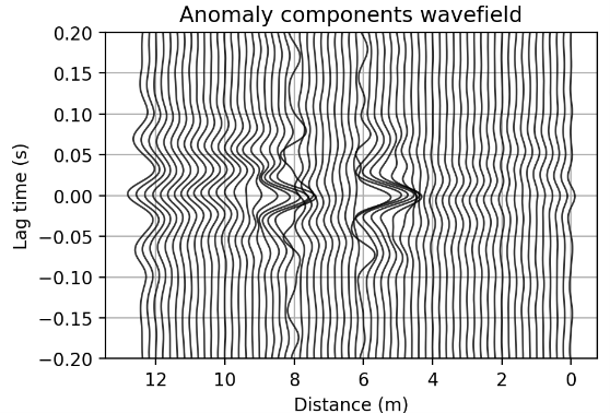
In a preliminary test involving an existing underground tunnel on Kobe University’s campus, DAS with spatial resolution as fine as 1 m enabled the two-dimensional extraction of anomalous responses associated with a tunnel approximately 2 m wide and located about 10 m below the ground surface. The results also provided information corresponding to the tunnel’s alignment and width. Under the conditions of this test, a depth of 9.3 m was estimated using an effective frequency range of 10–15 Hz at the cavity location and an S-wave velocity of 228 m/s estimated through seismic interferometry. This result was consistent with the known depth of approximately 10 m.
Road cave-ins, underground cavities, and ground loosening associated with aging sewer pipelines and underground infrastructure are major maintenance challenges with significant social impacts. Neubrex aims to apply this technology to identify potential risks such as underground cavities, loosened ground, and abnormalities around pipelines, prioritize detailed investigations, and monitor changes over time. Together with Kobe University, Neubrex will continue validation in actual field environments.
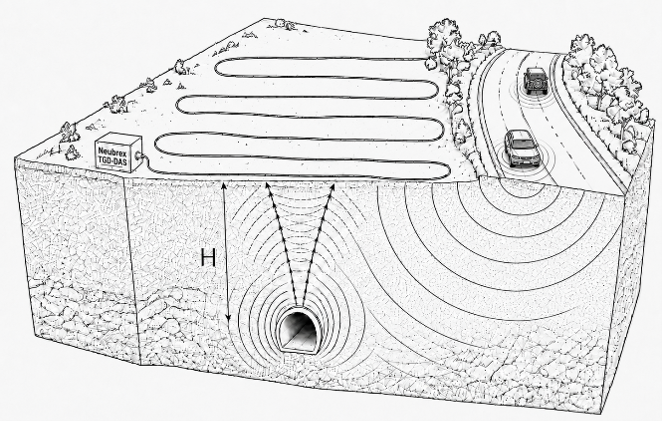
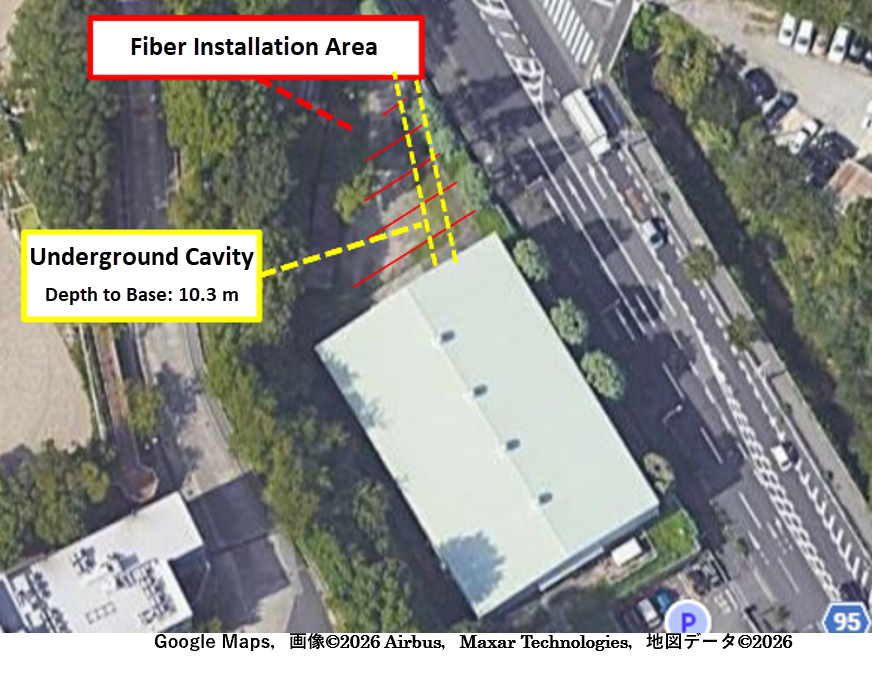
Visualizing underground cavity risks using optical fiber laid on the ground surface and ambient vibrations generated by vehicle traffic
Overview of the Technology and Research Findings
“Shallow Subsurface Risk Visualization” is a technology concept that uses optical fiber laid on the ground surface to perform distributed measurements of ambient vibrations and visualize localized anomalies in vibration response associated with potential risks in the shallow subsurface. DAS, or Distributed Acoustic Sensing, is a technology that continuously measures vibration and strain rate along an optical fiber.
In the preliminary test involving an underground tunnel on Kobe University’s campus, DAS measurements of ambient vibrations were conducted for nine hours overnight using optical fiber arranged in a two-dimensional layout on the ground surface. Seismic interferometry was then applied to extract anomalous components corresponding to the location of the underground tunnel. The tunnel examined in the test has a horseshoe-shaped cross section approximately 2 m wide and 2 m high and is located about 10 m below the ground surface.
In this analysis, localized vibration responses that differed from those of the surrounding areas were extracted from the acquired ambient vibration data and expressed as an Anomaly Index. By mapping anomalous points along each measurement line in two dimensions, the analysis confirmed information corresponding to the location, alignment, and width of the underground cavity. The analysis of the approximately 2 m-wide underground tunnel also confirmed that the fine spatial resolution of 1 m contributed to the clear identification of anomalous areas.
Validation Toward Lower Deployment Costs
In this test, measurements were also carried out using a coated optical fiber and a telecommunications fiber-optic cable, or “dark fiber”, in addition to Neubrex’s embossed strain-sensing cable. The results confirmed that the coated optical fiber provided signals suitable for this measurement method, comparable to those obtained with the embossed strain-sensing cable.
Because coated optical fibers are inexpensive and easy to install, they are considered to have significant practical value for large-scale field deployment. In contrast, the dark fiber used in this test exhibited substantial signal degradation, indicating that it was unsuitable for this measurement method. Neubrex will continue to rely primarily on purpose-built fiber-optic sensing cables as the basis for highly reliable measurements while also exploring flexible deployment models that include coated optical fibers, depending on site and cost conditions.
Future Development
Through this preliminary test, Neubrex and Kobe University confirmed the potential to capture a range of wave responses associated with shallow subsurface structures by analyzing ambient vibrations near the ground surface. Building on these findings, they will evaluate the applicability of the technology to water and sewer pipelines, water conveyance tunnels, cavities beneath roads, and loosened ground around pipelines through field validation with infrastructure operators.
Neubrex will advance the practical implementation of “Shallow Subsurface Risk Visualization” as a technology for the early identification of potential risks posed by underground cavities and loosened ground, the prioritization of detailed investigations, and the monitoring of changes over time.
The PDF is available here.
Contact
Neubrex Co., Ltd.
https://www.neubrex.com/
E-mail: info@neubrex.com
