
Civil Engineering & Construction

1Underground Cavity Exploration Test Using Fiber Optic DAS and Ambient Vibration
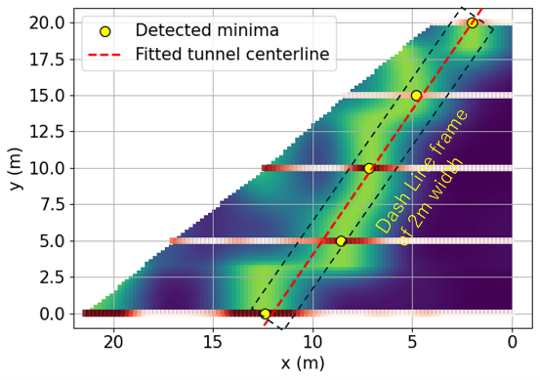
- ✔︎ Ambient vibration was measured using optical fibers arranged in a two-dimensional layout on the ground surface, enabling detection of an underground cavity located approximately 10 m below ground
- ✔︎ Demonstrated the effectiveness of our DAS interrogator, which enables high-spatial-resolution measurements at 1 m
This study demonstrates the detection of an underground cavity using distributed acoustic sensing (DAS) with optical fibers installed on the ground surface. Multiple optical fibers were arranged in a two-dimensional layout above an underground tunnel approximately 2 m wide and located about 10 m below ground. Ambient vibrations, including those generated by traffic, were continuously measured over an extended period. An anomaly index was calculated from the acquired vibration data, and the results from each measurement line were mapped in two dimensions to visualize the anomalous area corresponding to the underground cavity.
The analysis confirmed that DAS measurements with a high spatial resolution of 1 m or less are important for detecting an underground cavity approximately 2 m wide. Seismic interferometry analysis yielded an S-wave velocity of 228 m/s and a resonant frequency of 6.1 Hz at the cavity location, from which the cavity depth was estimated to be 9.3 m, in good agreement with the actual depth of approximately 10 m. In addition to a dedicated fiber optic sensing cable, effective signals corresponding to the underground cavity were also obtained using a low-cost, easy-to-install coated optical fiber.
Source: The 81st Annual Meeting of the Japan Society of Civil Engineers (September 2026),© Japan Society of Civil Engineers
2Real-Time Monitoring of Grout Filling
- ✔︎ Real-time visualization of grout level during filling using DFOS
- ✔︎ Confirmation of grout filling conditions from temperature distribution, demonstrating applicability to quality control during construction
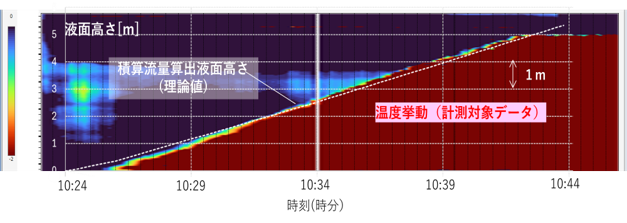
This case involved real-time monitoring of grout filling between double steel pipes using distributed fiber optic sensing (DFOS). A fiber optic sensor cable was installed between the steel pipes, and the temperature distribution along the fiber was continuously measured by utilizing the temperature difference between the grout and the surrounding environment. The measurement results were displayed as a color contour map, enabling the rise of the grout level during filling to be visualized in real time.
The grout level detected by DFOS was compared with the theoretical level calculated from the cumulative flow volume of the injection pump. The two results were generally consistent, confirming that the grout was being filled as planned. These results demonstrate the potential of DFOS for monitoring filling conditions during construction and supporting quality control, rather than relying solely on post-construction inspection.
Source: The 81st Annual Meeting of the Japan Society of Civil Engineers (September 2026),© Japan Society of Civil Engineers
3 Monitoring of Water Transmission Pipeline and Surrounding Conditions (Joint Research with Hanshin Water Supply Authority and Kobe University)
- ✔︎ Fiber optic cables installed between the existing tunnel and the newly constructed water transmission pipeline
- ✔︎ Aiming to enhance maintenance by verifying grout filling quality during construction and monitoring pipeline conditions and ground movement after commissioning
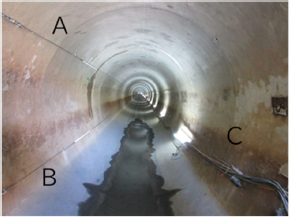
This project is a joint research initiative conducted as part of the renewal of the Third Ashibedani Water Conveyance Tunnel by the Hanshin Water Supply Authority. Fiber optic sensor cables were installed in the grout-filled space between the existing tunnel and the newly constructed water transmission pipe to enable continuous monitoring from construction through operation. By arranging multiple fiber optic cables at different positions within the tunnel cross section, the project aims to capture deformation of the water transmission pipeline and changes in surrounding conditions in a distributed manner, contributing to preventive maintenance of buried pipelines.
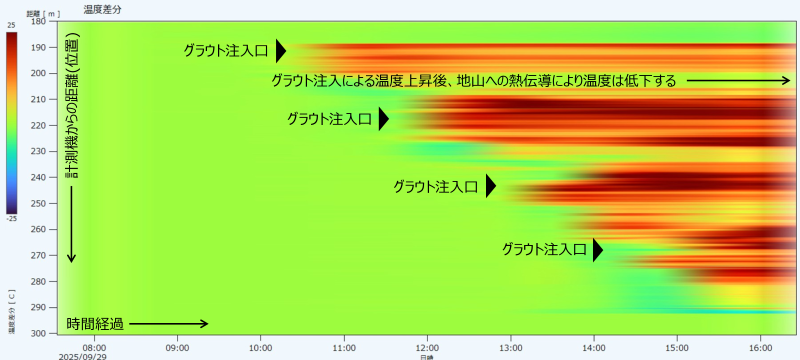
During grout filling, distributed fiber optic sensing (DFOS) was used to continuously measure the temperature distribution along the fiber and its changes over time. The measurements captured temperature increases corresponding to the grout filling locations, the peak temperature associated with the hydration reaction, and the subsequent cooling and stabilization process, confirming the applicability of DFOS to temperature management and quality evaluation during grouting.
View PDF in Japanese(2)
Source: The 81st Annual Meeting of the Japan Society of Civil Engineers (September 2026),© Japan Society of Civil Engineers
4 Measurement of Steel Pipe Behavior in the Extremely Long Pre-Supporting Method (ELPS) During Tunnel Excavation
- ✔︎ High-precision, high-resolution measurement of the actual behavior of steel pipes used in the Extremely Long Pre-Supporting Method (ELPS)
- ✔︎ Continuous, high-precision visualization of changes in axial force, bending, and deflection using optical fiber sensing
This case study involved the installation of approximately 45 m long steel pipes using the Extremely Long Pre-Supporting Method (ELPS) in weak ground near the portal of the Miyama Tunnel in Japan. Four optical fiber sensing lines were integrated into the steel pipes along their longitudinal direction at the top, bottom, left, and right positions, enabling continuous measurement of tensile and compressive behavior in both the vertical and horizontal directions. The acquired data were visualized as contour maps, clearly showing the location, extent, and changes in strain from ahead of the tunnel face to the excavated section behind it. This enabled a three-dimensional evaluation of the effective range and affected area of the long steel pipes.
The measurement results showed that bending compression began to occur in the steel pipes approximately 5 to 6 m ahead of the tunnel face, while significant deflection occurred within approximately 2 m behind the face immediately after excavation. These measurements clearly captured detailed changes in internal forces that were difficult to identify using conventional measurement methods.
Source: Proceedings of the 67th Annual Meeting of the Japan Society of Civil Engineers (September 2012), © Japan Society of Civil Engineers
